
MCP server vs REST API: When should you use each?
REST APIs have long been the default way for applications to expose functionality, but AI agents change how clients discover and use it. The Model Context Protocol (MCP) gives agents a standardized way to find and call external tools and services, which makes it easy to confuse with REST. This post covers how the two differ and when to choose each.
What is a REST API
REST (Representational State Transfer), RESTful APIs or RESTful web APIs are application programming interfaces (API) that follow REST architectural constraints for communication between client and server. In a REST API, each endpoint performs a specific operation using standard HTTP methods (GET, POST, PUT, DELETE). A typical interaction includes the client sending a request, the server responding at the designated endpoint route, and the connection closing.
Key characteristics of REST API
REST APIs are built on the REST principles and have the following characteristics.
Statelessness
One defining property of a REST API is statelessness, in which each request must include all the information needed to process it. As a result, servers do not need server-side sessions or data related to the client request.
Uniform Interface
Resources reside at the same address (URI) and their representations have a consistent format. Any client, such as a web front end or mobile app, interacts with the API through a uniform interface. Responses use a universally supported format, predominantly JSON, that any consumer can interpret.
Predictable nature
In the REST API, the same input produces the same output. Calling the API with a filter returns the same response every time for the same data state. This behavior matters for compliance and auditing for regulated industries where data auditability is required.
Client-Server Decoupling
In a REST API design, the client and server are independent. The client knows the URI of each resource, which is the only way to interact with the server. Similarly, the server application must pass the requested data to the client and should not change anything on the client.
Cacheability
REST APIs support caching to store data in client- or server-side caches. Caching provides a performance edge over calling endpoints repeatedly or re-executing methods.
Layered System Architecture
In REST APIs, requests and responses pass through different layers. Calls and responses don't connect directly; several intermediaries are involved in the communication loop.
Where REST API offers advantages
REST APIs are general-purpose communication solutions between clients and servers. Any client, whether a web application, mobile app or a microservice, can use another system's functionality or data. It has maturity of 20-odd years and several tools built around it: OpenAPI specifications, Swagger UI, Scalar UI, CDNs, and rate limiters. REST API provides common ground for business integration, where two companies can use each other's facilities, like a weather API, Twilio messaging, and LLM prompting. All of these are easier because REST APIs have a deterministic, universal structure for requests and responses. You know the URL, have an API key for authorization, and you're done integrating in one go.
For traditional applications, a REST API is ideal. Developers know the endpoints to use on the client. Endpoints are an abstraction of the server. Both sides use the documentation to understand each other, so there's no need to dig into details and complexity. A mobile developer doesn't need to know how tables are normalized, what logic is in the code, or which ORM the server uses.
Traditional systems also benefit from their architecture, which supports HTTP caching, content delivery networks, load balancers, and API gateways for REST. You get low latency and high throughput due to its architecture, lightweight JSON data format, and caching ability.
What does REST API lack?
As LLM-powered agents rise, traditional applications fall short. All the data transfer that has been done via REST API for decades does not match the new kind of user. By design, REST APIs serve human developers who hardcode endpoints in the client. However, agents are different clients, bringing the following gaps.
Limited runtime discoverability
REST endpoints do not tell users what they do. We have an OpenAPI specification, but it is static and does not offer LLMs the ability to discover descriptions at runtime. OpenAPI is basically an API description/documentation format rather than a runtime interaction mechanism.
Limited support for multi-turn interactions
There is no standard REST mechanism for an API to suspend an operation and request additional user input or approval as part of the same protocol interaction. Applications can implement such workflows themselves, but that requires additional application-level logic.
Inconsistent integration patterns across APIs
Different APIs expose different endpoint structures. Authentication, parameter formats, endpoint naming, pagination, error formats, filtering, naming, and workflows vary application to application. Humans know them from documentation and handle them manually. However, automated consumers have to rely on individual adapters' own assumptions and edge cases for every API they use. This complexity grows when an agent needs to work across many services.
High context and tool-definition overhead
REST API principles are designed for composability and discoverability for humans. Usually, APIs have atomic endpoints, and developers combine them for a task. Integration and iteration are cheap and deterministic as developers do this. This overwhelms AI agents, which pay a token cost for every tool definition. The issue isn't that REST is badly designed for models. It's that traditional REST APIs were designed around application-to-application interaction, while LLM agents have additional context and reasoning constraints.
What is MCP
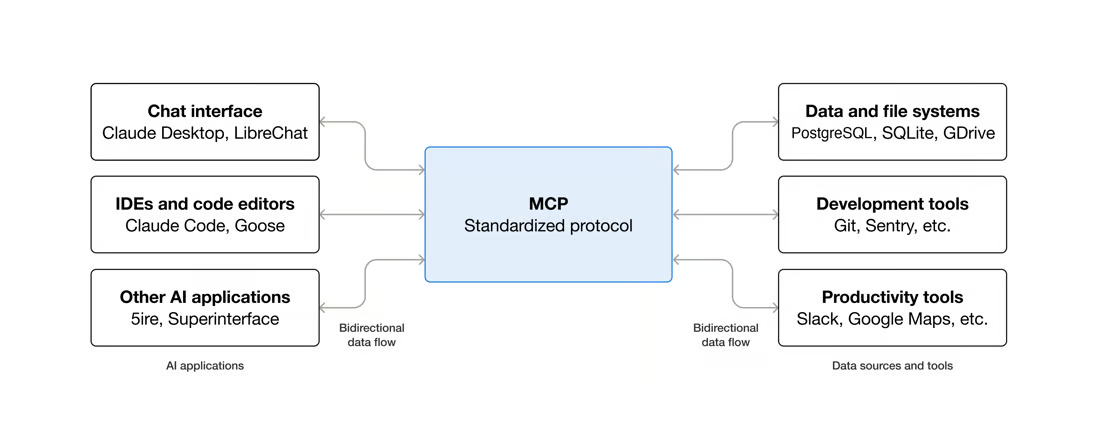
Model Context Protocol is an open-source standard introduced by Anthropic in 2024 that connects AI applications to external data sources, tools, and workflows. MCP is to AI applications what USB-C is to laptops. A laptop with USB-C ports can connect to any peripheral (monitors, drives, power supplies) regardless of manufacturer, because they all share a common standard. Similarly, AI chatbots like Claude, Gemini and ChatGPT, development assistants like Visual Studio Code, Cursor, Windsurf, Claude Code and many others support MCP, enabling build once and integrate everywhere.
Key characteristics of MCP
MCP defines a standardized protocol for AI applications to interact with external systems with the characteristics listed below.
Standardized primitives
MCP servers expose three primary types of capabilities:
- Tools are executable functions that an AI application can invoke. A tool can perform an operation, query data, call an external service, or trigger an action. A tool contains definition including a name, description, and parameters it accepts.
- Resources provide data or contextual information to an AI application. They can represent files, database content, documents, or other information that a server makes available to clients.
- Prompts are predefined reusable prompt templates that servers can provide to guide interactions with the AI model.
An MCP server may or may not expose all three independent primitives. It can provide only the capabilities its use case requires.
Runtime capability discovery
MCP provides standardized methods for clients to discover the capabilities exposed by a server. For example, a client can call the tools/list to retrieve a list of the tools available from an MCP server.
Consider the example below where a tool definition has its name, description, required validation and JSON Schema describing its input parameters.
{
  "name": "get_weather",
  "description": "Get current weather information for a location",
  "inputSchema": {
    "type": "object",
    "properties": {
      "location": {
        "type": "string",
        "description": "City name or coordinates"
      }
    },
    "required": ["location"]
  }
}
The same discovery model applies to resources and prompts through resources/list and prompts/list. This lets clients obtain a machine-readable description of the capabilities the server exposes at runtime.
Structured tool invocation
After discovering a tool, an MCP client can invoke it using the standardized tools/call operation. The client supplies the tool name and the arguments defined by the tool's input schema.
For example, an MCP server could expose a create_support_ticket tool. The AI client provides structured arguments such as the customer's ID, issue description, and priority. The server validates the request, creates the ticket in the underlying system, and returns the result through the MCP protocol.
MCP defines how tools are exposed and invoked, not how they work internally. A tool can query a database, call an API, execute application code such as a .NET method, or interact with another external service.
Resources and contextual data
Resources provide a standardized way for MCP servers to expose information to clients. A resource can represent content such as a document, file, database record, or other application data.
Resources are identified by URIs and can provide structured or unstructured content. Clients can discover available resources and retrieve their contents through the MCP protocol.
Stateful sessions
MCP supports stateful client-server sessions. During initialization, the client and server negotiate protocol versions and capabilities before normal interactions begin.
A session can then contain multiple protocol interactions, allowing the client and server to maintain protocol-level state throughout the connection. MCP also defines lifecycle messages, notifications, and capability negotiation as part of the session model. Sessions maintain context across multiple tool calls within a workflow.
Human-in-the-loop interactions
MCP defines interaction mechanisms that allow servers to request additional information or authorization from the client when required.
For example, a server can request user input through an elicitation interaction, or a client can be asked to obtain authorization before a sensitive operation proceeds. These mechanisms allow MCP interactions to include additional steps rather than being limited to a single request followed immediately by a final result. Human involvement is a recommended approach when a workflow is done by an AI.
Standardized protocol communication
MCP uses JSON-RPC 2.0 for messages exchanged between clients and servers. The protocol defines standardized requests, responses, and notifications for operations such as initialization, capability discovery, tool invocation, and resource access.
This provides a common communication model for MCP clients and servers while leaving the implementation of the underlying business logic to the server.
Where MCP offers advantages
MCP offers the following advantages for AI stack.
Reduced integration maintenance
An MCP server provides a standardized interface for exposing capabilities to compatible AI clients. Any changes in the tools or resources are handled on the server side. MCP requires less work in maintenance. You have to build once, and it is compatible with all AI agent clients. For example, an organization can change how a search_customer tool retrieves its data without changing the tool's interface used by the AI application, provided the published contract remains compatible. So you need no changes on the client side.
Adaptive task execution
MCP allows AI applications to discover available tools and their input schemas. The application can access structured information about the operations it can use. This information allows an application to select tools based on the task at hand, rather than requiring every possible workflow to be explicitly encoded in application logic.
For example, a customer says "my order never arrived." The agent decides it needs order status, shipping-carrier tracking, and the refund policy. Each piece of information may require different endpoint calls or have different parameters. It pulls those, then either explains the delay, issues a replacement, or escalates to a human if the case is unusual.
More focused information for models
MCP tools can return results specifically shaped for the task an AI application is performing. A tool does not have to expose the complete response produced by an underlying system, its implementation can retrieve, filter, transform, and format the information before returning it. This can reduce the irrelevant information the model needs to process.
MCP vs. REST APIs: Distinctions
Architectural Differences
The difference starts from the core architecture between the two.
| Dimension | REST API | MCP |
|---|---|---|
| Protocol | HTTP-based API using methods such as GET, POST, PUT, and DELETE |
JSON-RPC 2.0-based protocol for MCP interactions |
| Primary abstraction | Resources and HTTP endpoints | Tools, resources, and prompts |
| Capability discovery | Commonly described through OpenAPI or other documentation | Runtime discovery through MCP protocol operations such as tools/list and resources/list |
| Schema | OpenAPI can describe request and response schemas | Tool definitions use JSON Schema for their inputs |
| Communication | Requests sent to resource-oriented URLs | Requests sent as protocol methods such as tools/call |
| Lifecycle | HTTP request/response model | Protocol-defined lifecycle and capability negotiation; the 2026-07-28 revision uses a stateless request model |
| Underlying systems | Can directly expose application and data operations | Can expose capabilities backed by databases, APIs, files, services, or application logic |
Interaction Differences
| Step | REST API | MCP |
|---|---|---|
| 1. Determine available operations | Client uses known API endpoints and documentation/schema | Client can discover capabilities exposed by the server |
| 2. Select operation | Application code determines which endpoint to call | AI application can select an available tool based on the task |
| 3. Construct request | Application constructs the HTTP request and payload | Client invokes the MCP operation with structured arguments |
| 4. Process result | Application handles the HTTP response | Client processes the tool/resource result |
| 5. Next operation | Application code determines the next request | AI application can use the result as context for subsequent tool selection |
The difference lies in where the decision about available capabilities and the next operation can be made: REST clients commonly encode this logic in application code, while MCP provides protocol mechanisms for exposing capabilities that an AI application can discover and invoke.
Discovery Mechanisms
| REST API | MCP | |
|---|---|---|
| Typical mechanism | API documentation, OpenAPI, SDKs, or other descriptions | MCP discovery operations |
| When discovered | Often during development or client configuration | Can be discovered at runtime |
| What is discovered | Endpoints, operations, parameters, schemas | Tools, resources, prompts, and their associated metadata |
| Example | OpenAPI describes GET /customers/{id} |
tools/list returns available tool definitions |
| Client behavior | Client/application is generally built around known API operations | AI application can inspect available capabilities before selecting a tool |
Performance Trade-offs
Different architectures and working mechanisms also have distinct performance characteristics. Consider the table
| Dimension | REST API | MCP |
|---|---|---|
| Protocol overhead | HTTP request/response overhead | MCP adds protocol-level message handling on top of its transport |
| Single operation | Can be very direct when the client already knows the endpoint | Includes MCP protocol processing and tool invocation |
| Discovery overhead | Depends on how API documentation/schema is obtained | Capability discovery introduces additional protocol interactions when needed |
| Payload size | Depends on API response design | Depends on how the MCP server shapes the tool/resource result |
| LLM context | Depends on what the application supplies to the model | Tool descriptions and returned results become part of the model-facing context |
| Overall workflow | Application controls the sequence of API calls | AI application may dynamically select and chain capabilities |
MCP should therefore not be characterized as inherently faster or slower than REST. Relevant performance characteristics depend on what you measure. A direct API call may have less protocol overhead than going through an MCP server, while the overall cost of an AI workflow also depends on capability discovery, the number of tool calls, response size, model inference, and backend operations.
REST API and MCP: Partnership, Not El Clásico
Considering the AI stack and future trends, REST API and MCP are not two poles, but two friends that work together in a comprehensive modern solution.
MCP as an AI-friendly layer over REST
MCP exposes tools that an AI agent can call. For most tools, it translates each invocation into the corresponding REST API request. APIs remain a great interface for an application to share its features and data with other applications, such as your system providing available flight information. MCP adds a layer on top for a universal protocol. It handles discovery and tool semantics for such endpoints. Tool invocation executes the remaining operations specified by the API server. In other words, REST APIs are a common way for an application to provide an interface, while MCP makes that interface usable and discoverable for AI agents. MCP server you use in Stripe, Salesforce, Slack, GitHub, or Notion is typically a thin, intelligent layer over native APIs. To meet AI-powered development, layer the API with MCP.
Design endpoints for agent tasks
A REST API has atomic endpoints for single tasks. Human developers use each get_user, get_orders, and get_shipments separately and integrate them in place. Human iteration is cheap, they can go to the documentation and find the right endpoint to use. Our automated consumers have expensive iteration, it must load every tool description into their context window. Every extra tool costs tokens and latency on every single interaction.
Keep this in mind when designing MCP with an API. Many single-purpose endpoints like get_user, get_orders, and get_shipments will hurt token price and performance. Expose a single endpoint, track_order(email), that does the job of all 3 internally and returns a complete, contextualized response.
Authentication: REST Flexibility vs. MCP standardization
REST APIs support several authentication methods, such as OAuth 2.0, bearer tokens, custom headers, Single Sign-On (SSO), 2-Factor authentication, Passwordless authentication, mutual TLS and API keys. Such a wide range of options offers you reliability for every requirement. However, each has complexity and needs its own implementation.
MCP takes a more standardized approach for remote authorization. It follows OAuth 2.1 with PKCE as the standard. MCP has gone through a lot of evolution since its inception. Maintainers have identified bottlenecks in the authorization implementation, for which MCP adopted authorization-server discovery, token validation, and scoped access. The current 2026-07-28 revision also includes changes around issuer validation, credential binding, and authorization scopes. Permission restriction matters because AI acts on behalf of the user. To achieve this, MCP can support authorization at the server or individual-tool level, allowing sensitive capabilities to require authorization while leaving other capabilities public.
MCP does not replace authentication or authorization, but it standardizes the interface between the AI application and the MCP server, while the underlying service can retain its own authentication and authorization model.
Use A Hybrid REST and MCP Architecture
For many production systems, the practical choice is not REST or MCP but REST and MCP. You shouldn't turn your existing APIs upside down for MCP. Existing REST APIs can continue serving applications, integrations, scheduled jobs, webhooks, and other deterministic workloads, while an MCP server provides an AI-friendly interface to the same underlying capabilities. MCP servers expose tools, resources, and prompts that AI applications can discover and use.
Design a hybrid model where REST can handle high-volume data ingestion, business logic abstraction, webhooks, and application-to-application integrations. An MCP layer can then expose higher-level capabilities such as querying customer information, checking an order, generating a report, or initiating an approved workflow. Both interfaces can ultimately operate on the same backend services and data.
Future Trends in APIs and Protocol Innovation
What we have been observing since the dawn of LLMs is that more and more applications are adopting AI in their workflow. Major technology companies like Google, Meta, Amazon and many others have integrated artificial intelligence into their core applications to enhance search, productivity, and user experience. This trend paved the road to other companies. In the future, we expect to see:
- APIs will become more agent-aware, and APIs will increasingly be designed for both traditional applications and AI agents as software gains new types of consumers.
- AI agents will become active API consumers. Instead of only retrieving data, agents will increasingly discover capabilities, make decisions, and perform actions through APIs.
- Natural-language interaction will grow, where users will increasingly interact with applications through conversational interfaces rather than navigating every workflow manually.
- Hybrid API architectures will become common where REST will continue serving traditional clients, while protocols such as MCP provide a standardized interface for AI agents.
- API capabilities will become more discoverable and future APIs will provide richer descriptions of available operations, inputs, outputs, permissions, and constraints so agents can use them reliably.
- Applications will increasingly adopt self-optimizing pipelines that adjust based on performance feedback and enhance user experience.
REST API vs MCP: When to use what?
We have seen architectural and usage differences between REST API and MCP. Now the question arises: which one fits where?
When to choose REST API
- Web and mobile applications where the client is user-written and developers know what to call.
- High-volume and performance-sensitive data retrieval where HTTP caching, CDNs, load balancing, and other established HTTP infrastructure can reduce latency and improve scalability.
- Public or broadly accessible APIs where compatibility with standard HTTP clients and existing API tooling is a priority.
- Microservices where backend services exchange data through stable and well-defined API contracts.
Go for MCP when
- AI is your consumer where you're building for Claude, ChatGPT, Cursor, or any LLM-powered tool
- Agent workflows require user confirmation. MCP supports interactions where a tool can pause during a workflow and obtain additional input or approval before performing a sensitive, destructive, or costly operation.
- You want reusable AI integrations. An MCP server can expose your existing capabilities through a standardized interface that multiple MCP-compatible clients can use.
Conclusion
Your applications may not be restricted to human users. AI-powered agents are increasingly a new species that interact with your applications. Your backend REST APIs were enough for the traditional request cycle, but AI's dawn brought a new standard for applications: MCP. We discussed each of them in detail and compared the differences. In this post, I shared how you can use REST API and MCP together as they're complementary layers in today's AI stack. Then I pointed out which one suits which scenario. My final recommendation in this ever-evolving ecosystem is to selectively and gradually add MCP to the applications where an AI agent will be part of the equation.
elmah.io: Error logging and Uptime Monitoring for your web apps
This blog post is brought to you by elmah.io. elmah.io is error logging, uptime monitoring, deployment tracking, and service heartbeats for your .NET and JavaScript applications. Stop relying on your users to notify you when something is wrong or dig through hundreds of megabytes of log files spread across servers. With elmah.io, we store all of your log messages, notify you through popular channels like email, Slack, and Microsoft Teams, and help you fix errors fast.

See how we can help you monitor your website for crashes Monitor your website